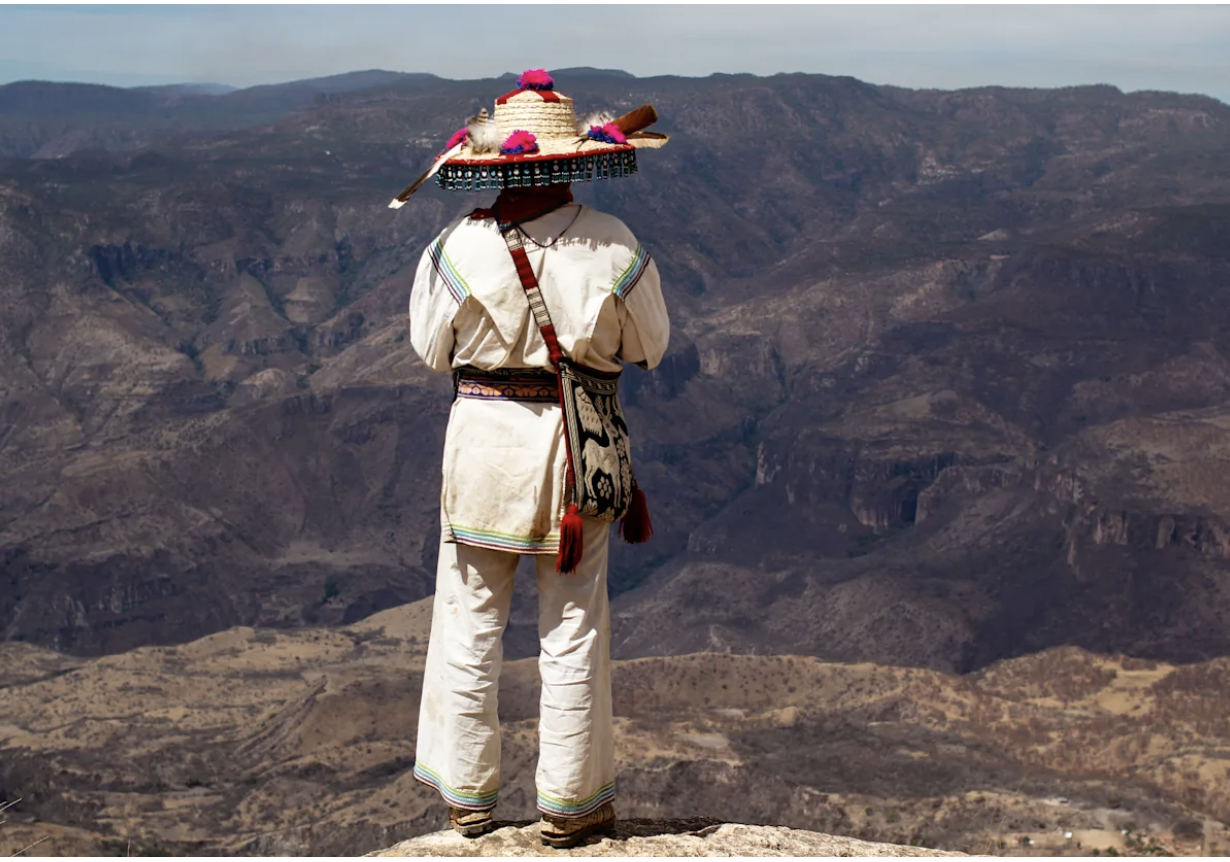
Federal Court Orders the Annulment of Mining Concessions in Wirikuta
The Fourth District Court in the State ruled to grant *amparo* protection to the Wixárika people and ordered the corresponding authorities to nullify the mining concession titles within the Wirikuta Natural Sacred Site Protected Natural Area; furthermore, it mandated that, henceforth, any granting of concessions must be subject to consultation.
In accordance with the ruling in *amparo* proceeding 819/2011, federal judicial protection is granted to ensure that the Secretariat of Economy and the Directorate General of Mines—acting within the scope of their respective competencies—nullify the 44 mining concession titles, as well as all legal consequences deriving therefrom.
Once this has been accomplished, the authorities must issue a new determination regarding the feasibility of issuing the requested titles; should it be determined that the requisite conditions and requirements have been met, and prior to granting said titles over lands from which the indigenous community derives benefit, the authorities must first conduct a consultation process with the Wixárika community.
This requirement is established in accordance with Articles 6, 7, 16, and other applicable provisions of International Labour Organization (ILO) Convention 169 concerning Indigenous and Tribal Peoples in Independent Countries.
The consultation must be conducted prior to the actual issuance of the mining concession titles. Its execution must adhere to the principles of being prior, free, informed, culturally appropriate, and conducted in good faith—that is, in conformity with the cultural traditions and/or customs of the indigenous community—and must be carried out through procedures involving the participation of the community's representative institutions and with the full consent of its members.
Furthermore, it was stipulated that the consultation process must be carried out in five phases or stages: pre-constitutive, informational, internal deliberation, dialogue, and, finally, decision-making. Among these points, it is noteworthy that, in the first phase, the following must be defined by mutual agreement between government authorities and representatives of indigenous communities: the specific concession titles intended for issuance; the indigenous peoples or communities likely to be affected; the form and stages the consultation process will follow, as well as the means by which community members are to participate; the identification of the communities' representative bodies; and the formalization of agreements to ensure their legal validity.
In the second phase—which consists of the consultation dissemination process—the authority must provide the consultation with substantive content comprising complete, prior, and meaningful information. In doing so, the authority must take into account that the administrative procedure commenced with the filing of the concession application, and that various administrative actions had already been undertaken prior to the issuance of the titles that were subsequently invalidated.
This information must include the particulars stipulated in Article 16 of the Mining Law Regulations, which specifies the data required to accompany a concession application. Such data includes: the name of the mining lot; its surface area; the municipality and state in which it is located; the names of the primary minerals or substances targeted for mining operations and works; the geographic coordinates of the starting point; approximate references to known landmarks and population centers within the area; and the access route from the nearest settlement—among other details—as well as information regarding any pre-existing mining lots, where applicable.
Furthermore, information must be provided regarding the expert assessments conducted by the designated mining expert. These assessments encompass the following stages: a review of background records, on-site reconnaissance, field surveys, office-based calculations, and the issuance of the expert report. Additionally, the communities must be informed of the authority's determination regarding whether said expert assessments comply with the provisions set forth in the Regulations and applicable Technical Standards.
In addition, the communities must be apprised—with clear differentiation—of the specific nature of the exploration and exploitation activities covered by the concessions; the technical methods to be employed in each respective phase; the potential negative impacts and anticipated benefits associated with each phase; the manner in which the community would share in any such potential benefits; and the measures to be implemented to guarantee their water supply or to mitigate any adverse effects upon it. It is imperative that the responsible authorities provide indigenous and Afro-Mexican communities with information regarding the rights conferred upon concession holders by concession titles, as well as the scope of said rights—including all those enumerated in Article 19 of the Mining Law.
Finally, as part of the information that must be made available to them, the mining authority must consult with the communities regarding what measures or adjustments could be implemented to avoid interfering with their traditions, rituals, festivities, and, in general, their way of life—with the understanding that some of these aspects have already been documented in the expert anthropological report submitted during the *amparo* proceedings.
The ruling establishes that, under no circumstances, does this imply that the effects of the *amparo* judgment must be restricted to the annulment of the act or norm; consequently, a measure of comprehensive reparation is also mandated. To achieve this objective, a series of measures are enumerated, including restitution, indemnification, rehabilitation, guarantees of non-repetition, and satisfaction.
In conclusion, the preparation of the judgment in a "plain language" format is also ordered, comprising a summary of the ruling—setting forth the most relevant points of the argumentation as well as the operative provisions—rendered in simple language, in both Spanish and Wixárika.