The Journey of the Dead
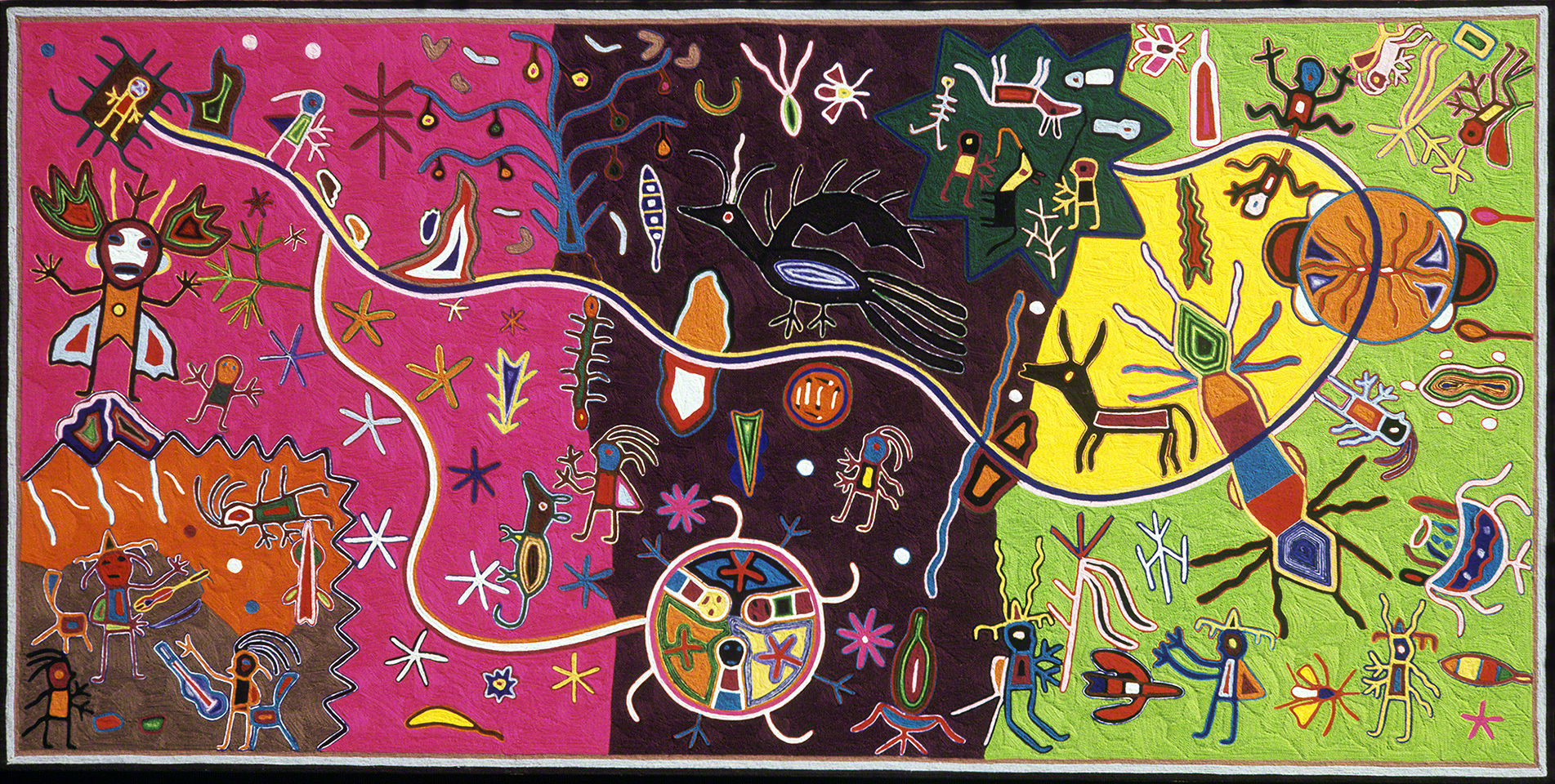
When a person has been dead for five days, a mara’akame (shaman) will attempt to bring the soul back from the land of the dead to its family for cleansing. To do this, the mara’akame must follow the path of the dead soul through its five-day journey. The dead person enters this path at the place of burial (top left). Dots represent chocolate and tortillas for the journey. A nierika, a mirror of sacred visions, is found at the start of the path by the mara’akame and in this he sees a trace of the dead soul. Footsteps direct themselves towards the top of a hill that tings like a bell when the dead climb it, announcing to those already there that a new soul is arriving. Two dead souls (below in the center section) are coming to watch their new companion. The searching mara’akame carries a stick crossed with thorny acacia twigs (depicted before him) for his protection.
The dead soul then finds itself in front of a wild fig tree. If male, the dead soul throws stones resembling female organs at the ripening fruit on the tree; while the female throws sticks to break off the figs that represent her sexual sins. Next appears a kuitemui beneath the tree, a worm with which he played as a child and stepped on. The worm now enters his rectum as vengeance.
The path crosses through the earth that has many colors: red, blue and yellow. There the dead finds a crow. When he cultivated his corn, he would chase the crow away to keep it from eating the kernels. He now gives it an ear of corn to be able to continue his journey. Below the crow, the dead soul drinks water (in the orange disk) which is filthy and full of worms, and he is reminded of the clean water he drank in life.
Here the mara’akame has found another nierika (depicted as an orange crescent above the crow) in which the shaman sees the soul has taken the form of a fly. The fly arrived at a river and he asked the dog on the other side to help him cross. The dog replied that he was never fed when his master was alive; instead he was beaten and kicked, so he would not help the fly. The dead soul had two tortillas that he threw to the dog, who then agreed to pass him over to the other bank. Here are found rocks that turn and clash. The soul is met by the opossum (depicted at right center in the pink field) who promises to punish the dead soul for having hunted him for food in his lifetime. But the dead soul escapes moving the rocks.
Further on, he may be thrown in a boiling pot (orange circle) for copulating. It is here the sins are left. If the man had been sexually intimate with any of his family but his wife, he is roasted in a skewer with his partner. If the dead soul is to be eternally punished, he gets stuck in the form of a fly on a candle and the mara’akame cannot retrieve him. If the soul had copulated with a person of Spanish blood, he is locked in a corral with a wild mule representing the former sexual partner, beaten with acacia thorns and forced to ride the mule, which throws him off and stomps him to a second death. Two newly killed bodies are depicted in the green corral; one body has become a skeleton.
The mara’akame and his assistant are sitting in their ceremonial seats (top right corner), a sacred mat between them. The mara’akame holds his plumed-arrow, which guides him in finding the dead soul. The dead person’s family has prepared a great feast to welcome the soul when the shaman catches it. Some of the offerings to the dead are (at right): two candles, a gourd of native corn-beer bursting with bubbles, a bowl filled with the dead soul’s favorite foods and an ear of multi-colored corn from the crop the he had harvested. The mara’akame and his assistant have prepared the arrow needed to shoot and capture the soul (lower edge). Behind the shaman there is a bottle of liquor as an enticement and a banana (further left).
The mara’akame is finally able to find the dead soul among a couple of musicians (lower left corner). Here the dead dance in a frenzy, lifting swirling dust. The musicians play a violin and a guitar. The dead soul brought with him deer hairs, corn grains and other possessions, which cause misery and illness to his family. The shaman hits the dancing soul with his arrow (in orange field). Thus he takes away those possessions and brings the soul to the feast in the form of a fly (lower right). The shaman offers the food and cleans the soul so it can go now to the sky, where Our Mother Young Eagle Girl, Tatéi Werika Wimari (large figure left center) receives the purified souls.
There is also the path of the innocent children who die in early age. This path crosses through the pink field, bordered by flowers of all sorts. It leads directly to a circular area with symbols of the four cardinal points. There are the souls of three dead children. A child is on the right of Tatéi Werika Wimari. Only those with a clean soul can join her after death because she is the mother who renews life.