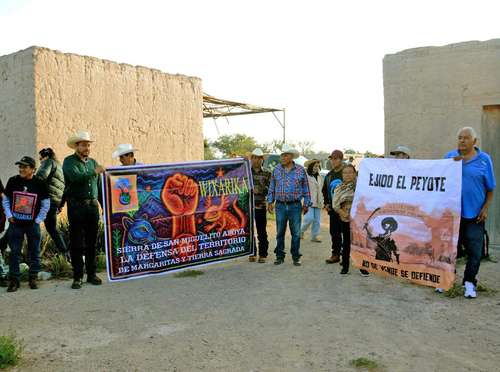
Judge Orders the Invalidation of 44 Mining Concessions in Sacred Zone of Wirikuta
Diego Galeana Jiménez, presiding judge of the Fourth District Court of San Luis Potosí, granted a writ of *amparo* (constitutional protection) to the Wixárika people, ordering the nullification of 44 mining concession titles located within the Wirikuta protected natural area and sacred site—concessions that had been issued during the six-year presidential term of Felipe Calderón Hinojosa (2006–2012).
With the ruling on *amparo* case 819/2011—handed down by Galeana Jiménez, a jurist elected during the recent restructuring of the San Luis Potosí Judiciary—these mining concessions are annulled on the grounds that the Wixáritari communities (the plural form of Wixárika) were not consulted prior to their issuance.
The ruling was issued on March 27; therein, the judge also established that any new mining concession proposed for issuance within Wixárika territory "must be subject to prior, free, informed, and culturally appropriate consultation with the community."
This ensures that decisions regarding mining activities respect their traditions, rituals, and way of life, and that the community is able to participate fully before any permits are granted.
Furthermore, the judge ordered comprehensive reparatory measures—consisting of restitution, financial compensation, and other actions—and mandated the creation of "a 'plain-language' version of the judgment, in both Spanish and Wixárika, so that the entire community may understand it."
The ruling recognizes the Wixárika people's right to protect their territory, water resources, and culture against projects that could adversely affect them, in accordance with the standards set forth in International Labour Organization (ILO) Convention 169 concerning Indigenous and Tribal Peoples.
"An Insufficient Resolution"
The judgment in *amparo* case 819/2011, rendered in favor of the Wixárika people, "represents a tremendous victory, as it mandates the invalidation of 44 mining concessions within Wirikuta"; However, Iracema Gavilán Galicia—a specialist in mining extractivism and lithium energy megaprojects, as well as a research professor at the National Autonomous University of Mexico (UNAM) and El Colegio de San Luis (Colsan)—warned that the mining concessions currently in force still outnumber those that have been annulled.
According to data provided by the academic, key sites along the historical-cultural route of the Wixárika people and the natural sacred site of Wirikuta—which last year was designated a Cultural Heritage of Humanity site by the United Nations Educational, Scientific and Cultural Organization (UNESCO)—had the following active concessions registered as of 2025: 63 in the municipality of Catorce; 16 in Charcas; eight in Villa de La Paz; and two in Matehuala. Located within the state of San Luis Potosí, these concessions were granted for the exploration and exploitation of minerals such as gold, silver, copper, zinc, cadmium, lead, molybdenum, and antimony.
“With the exception of gold, the rest are classified as critical minerals for the energy transition,” noted Gavilán Galicia.
She added that the companies holding the highest number of mining concessions within the Wirikuta Natural Protected Area as of 2025 were Compañía Minera y Refinadora Mexicana, Eleno Guerrero Coronado y Socios, Industrial Minera México, Minera Real Bonanza, Minera Real de Catorce, Restauradora de las Minas de Catorce, Sb Wadley, US Antimony, and Víctor Garate Naudin.
Furthermore, within Wixárika territory, concessions owned by the Mexican Geological Survey (SGM) remain in force: specifically, the Tamatsi Paritsika Iyarieya Mataa Hane mining reserve (Title No. 00302), issued on August 15, 2012, for the potential exploration and exploitation of gold, silver, lead, copper, and zinc. The SGM also holds the Tamatsi 3 concession—Title No. 00308—issued on the same date, August 15, 2012 (three and a half months before the end of Felipe Calderón’s presidency), likewise for the extraction of gold, silver, lead, copper, and zinc.
Furthermore, the UNAM-Colsan professor-researcher noted that, within the area covered by the UNESCO designation, the following mining concessions also remain in effect: one in the municipality of Pánfilo Natera, Zacatecas; and, within the territory of San Luis Potosí, four additional municipalities hold concessions—one in Santo Domingo, seven in Salinas (one of which is for lithium), ten in Villa de Ramos, and thirteen in Charcas.