History

| December 2011
The 2011 Pan American Games, to be held in October in Guadalajara, Mexico, have three mascots. One of them is Huichi, a caricature of the sacred Huichol deer, and according to Emilio González, Jalisco state Governor, and the Games Organising Committee, a "worthy ambassador of the Huichol". However, far from being a “worthy ambassador”, for the Huicholes Huichi represents a sacrilegious misuse of sacred Huichol symbology. If the government had bothered asking beforehand – which it didn’t – it would have found that out. In another sleight, the Huicholes, whose artisanry is famous worldwide, formally proposed having a fixed space to sell their artisanry during the games, but this was rejected, all of this by which time Huichi had already been made public. 
| May 2011
The Wixarika, known as Huicholes in Spanish, and as Wixaritari in their own language, are recognized as one of the Mexican native cultures most resilient to outside influences. Unlike most other Indians, they did not allow Catholic priests to perform mass within the three main communities in the Wixarika mountains, except sometimes on Wixarika terms just before Easter, and in one community, at a couple of boarding schools.
| January 2011
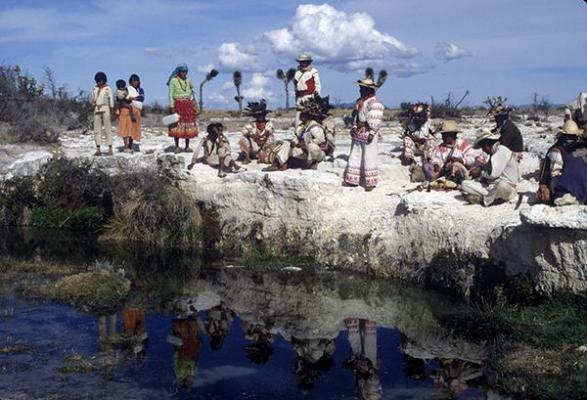
Wirikuta is one of the most important natural sacred sites of the Wixárika (Huichol) indigenous people and the world. The Wixárika people live in the states of Jalisco, Nayarit and Durango and are recognized for having preserved their spiritual identity. They have continued to practice their cultural and religious traditions for thousands of years. Wirikuta is the birthplace of the sun and the territory where the different Wixárika communities make their pilgrimage, recreating the route taken by their spiritual ancestors to sustain the essence of life on this planet. In this desert springs the peyote or jicuri, the cactus that the Wixárika ritually ingest to receive the “gift of seeing”.
| December 2005

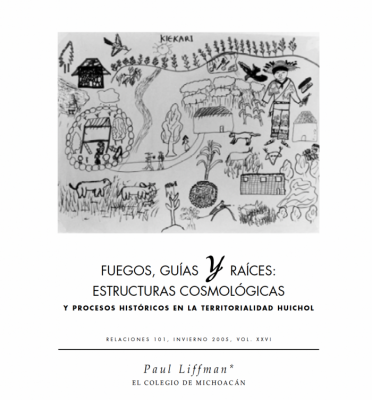
The cultural process of legitimation ("registry") of Wixarika land tenancy is analyzed with relation to the historical expansion and contraction of their residency patterns. The focus is on the social practices and relationships implicated in the concepts of Tatewarí (ceremonial fire), nana (vine or climbing plant) and nanayari (rootedness). Said residency pattern is rooted in the rancherías (kite) dispersed but organized hierarchically based on the synecdoche surrounding 20 large native temples (tukite) across 5,000 square kilometers of the Western Sierra Madre.

| January 2004
The Wixarika tradition is rendered by three different terms: the first refers to our heart/ memory, tayeiyari- the second to how we develop, tanuiwari- the third to our life, tatukari, is transmitted by families, reinforced by communal living on extended family ranches and through clans at ceremonial centers, tukite (tukipa, sing.). Three places serve as the headquarters for what appear to be distinct Wixarika subgroups, with ritual and dialectical variants.
| December 2003
As archaeologist Phil Weigand puts it, the Wixarika and their Na'ayeri neighbors had deep roots in the area where they are now settled in a sequence that had begun by the Mesoamerican Classic period (ca. 200-700 A. D.). The Corachol branch of this Uto-Aztecan language family leads linguists like Valiñas, cited by Weigand to consider the relative antiquity of this language group in the area.
| December 2003
The government has found it very difficult to ‘civilize’ the Huichol and integrate them as a dependent productive working class in the mountains. After independence was achieved from Spain, the laws of the reform passed under Benito Juárez during the 1850’s, restrained the power of the Catholic Church, but they also stopped recognizing Indian colonial land rights. Soon the Huichol, Cora, Tepehuan and Mexicanero Indian groups of the Western Sierra Madre were further dispossessed of their territory by their mixed blood neighbors. They rebelled, eventually uniting under Manuel Lozada, who joined French invading forces until they were stopped at Guadalajara, Jalisco, in 1873. Many of their land holdings were disenfranchised thereafter.
| January 2003
After independence was achieved from Spain in 1810, the laws of the reform passed under Benito Juárez during the 1850’s, restrained the power of the Catholic Church, but they also stopped recognizing Indian colonial land rights. Soon the Huichol, Cora, Tepehuano and Mexicanero Indian groups of the Western Sierra Madre were further dispossessed of their territory by their mixed blood neighbors. They rebelled, eventually uniting under Manuel Lozada, who joined French invading forces until they were stopped at Guadalajara, Jalisco, in 1873.
| August 2001
Juan Negrín was a top student at Yale in the late 1960s, but just before graduation he abandoned his studies to come to the Bay Area where a cultural revolution was in full swing. Negrín’s background is unusual. His grandfather was the Spanish President driven from power by Franco’s forces in 1939. His father married an American woman and Negrín was born in Mexico City. With an inherited bent for political action, Negrín was soon a participant in the Viet Nam protests in Berkeley and the volatile atmosphere of the 1960s. By 1970 Negrín had become discouraged by the spreading violence and drug use that had progressively altered the culture of protest. In a few short years, it had declined, as he put it, into “a sorry, directionless theater.”
| August 2000
The pilgrimage of the Huichol natives of Northwestern Mexico, known as Wixaritari in their language, to the Ocean is a vital phenomenon. Although they mostly live a good 100 kilometers from the coast of the state of Nayarit: That is where the sparks of Our Great-Grandfather the Setting-Sun, Tatutsi Sakaimuka, disappear as he enters one of his subterranean aquatic canals, and one waits for Our Father, Tayau, or Our Creator, Taweviékame, to reappear on the other side, in the sacred desert of the east, Wirikuta.