Culture

Sort by
Order
| January 2020
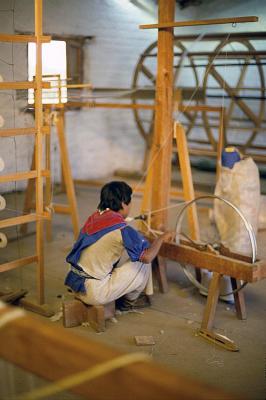
In the Wixarika community El Colorín, in the municipality of El Nayar, Nayarit, México, two economic-productive activities are mainly carried out: fishing and the elaboration of Wixarika art. There is also incipient tourism and ingrained but depleted livestock, as well as an almost extinct agriculture. But this has not always been the case, due to at some point agriculture predominated and at another time craftsmanship. In order to understand the transformations and re-accommodates that happened to reach what is now happening in El Colorín, it is proposed to analyze the everyday life in the Aguamilpa region, from the socialized individual in a particular space and time, based on the figure of José Ríos (Mats+wa), from a microsocial scale. To this purpose, the ways of life, especially from two periods, are presented as photographs showing the way in which it has been living in the region.
| March 2019
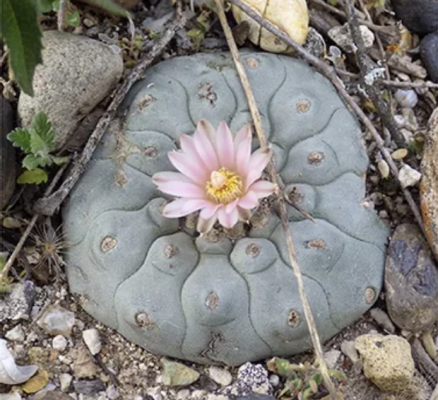
The focus of this article is to elucidate the unique roles women have in peyote religious practices of the Wixárika Indigenous people of Mexico and the Native American Church (NAC) in North America and Canada. Special consideration is given to the meanings associated with these female practicioners/participants in spiritual terms and physical experiences. In Wixárika thought, flowers symbolize both women and peyote (Lophophora williamsii, a small spineless cactus which contains mescaline). Flowers exude beauty, are indicators of fertility, and, through their reproductive anatomy, give new life via seeds. Women, likewise, have the wondrous ability to bring new life into the world. Akin to Wixárika notions of femaleness, women in NAC traditions personify the feminine essence in NAC peyote ceremonies. Schaefer emphasizes Wixárika peyote traditions because of her extensive fieldwork among women in that culture. Her intention is to bring awareness about entheogens in women’s lives.
| October 2018
In various forums and meetings on intercultural education in our country, several colleagues express the need to delve deeper into the daily life of the intercultural classroom through ethnographic research in order to understand its needs firsthand and be able to intervene appropriately: how teachers implement pedagogical programs, the use they make of pedagogical support materials – including texts for bilingual education –, what their pedagogical practices are like; in other words, to understand the problems in situ and, thus, be able to address them with the level and sensitivity required.
| July 2018
A group of 15 Wixáritari people have been working around the clock during the last seven weeks to finish the 32 pieces of an 882-square foot mosaic that will weigh two tons.
| June 2018

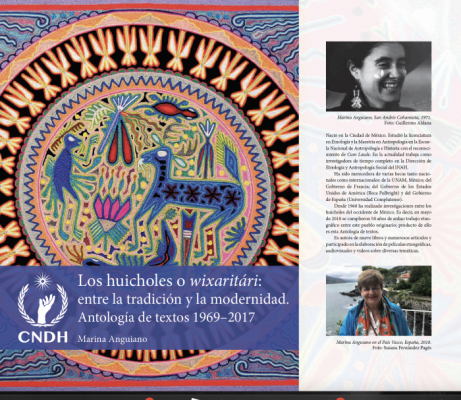
The present anthology gathers the work of Marina Anguiano Fernández (1945-2023). Born in Mexico City, she studied her Bachelors of Arts in Ethnology and Masters in Anthropology from the National School of Anthropology and History with the honors of Cum Laude. She worked as a  full-time researcher in the Direction of Ethnology and Social Anthropology in the National Institute of Anthropology and History (INAH for its Spanish acronym). She obtained several national and international grants from the UNAM, Mexico; French Government; Fulbright, United States; and from the Complutense of Spain.

| May 2018
En 1982, un escritor francés, Jean-Paul Ribes, viajó a México para escribir un artículo para la revista Actuel1 sobre el chamanismo y los psicotrópicos, tomando a los wixaritari (huicholes) como ejemplo de uno de los últimos pueblos chamánicos vivos. Por entonces, mi padre, Juan Negrín Fetter, figuraba como uno de los principales estudiantes de la cultura y el arte wixárika, por lo cual le llegaban solicitudes por parte de académicos, funcionarios y psiconautas con la esperanza de que él les pudiera facilitar un vínculo con las comunidades wixaritari. Mi padre apenas llevaba unos diez años trabajando con artistas wixaritari en Jalisco y Nayarit, pero en ese lapso de tiempo había logrado crear amistades íntimas con varias familias, asesoró brevemente al Instituto Nacional Indigenista y había unido su interés por el arte con la defensoría territorial de los wixaritari ante la deforestación y otras amenazas contra la autonomía de este pueblo originario. 
| May 2018
This article is a part of Medicine Stories, an exclusive series made possible by a grant from the Elna Vesara Ostern Fund. "The medicine is teacher, master; it is the Blue Deer, the one who determines from the four directions where the sacred song is summoned, where he teaches us to speak, how to heal, how to make cures, and that is why this is very sacred. Through the messages of the medicine, we cure ourselves in the ceremony. There we see the news and the ancestral messages, and we see how we have to act." — Mara’akame Juan José Ramírez, “Urruamire”
| January 2018
In this scholarly article, linguists present a morphological segmenter for the Wixarika language. Segmentation is fundamental for rich morphological languages, a common aspect of the Indigenous languages of the Americas, to improve other tasks like automated translation, dialogue systems, summarization, etc. On top of the agglutinative nature of the language, the low amount of resources and the lack of an orthographic standard among dialects add to the challenge. Their proposal is based on a probabilistic finite-state approach that exploits regular agglutinative patterns and requires little linguistic knowledge. They seek to show that their approach outperforms unsupervised and semi-supervised methods in a low-resource context. The dataset used in this work was openly released for future work by the community.
| January 2018
Wixáritari (pl.) from Western Mexico perform a series of ceremonies through the cultivation and harvesting of Corn. In communities outside Wixárika land, families align their ceremonies to the academic calendar and working calendar to ensure the families’ participation. This article discusses the active role of Maize within ceremony from cultivation to harvesting, emphasizing the role of women in preparing Corn-based substances for ceremonial offerings. Through storytelling and embodied practices such as gastronomic representations, women are active agents in transmitting the relationships between Corn and community members. Drawing from my ongoing ethnographic fieldwork among Wixárika families in Tepic, Mexico, the article analyzes the ontological relationship between Wixárika and Corn. Utilizing verbal performances such as storytelling, this article highlights the importance of Maize for purposes of continuing the community’s connection to geographies, identity and the significance of women in enabling inter-species relations.
| January 2018

The Wixárika ethnic group of Northwestern Mexico is accustomed to high rates of maternal and infant mortal ity, and until the 1970s they had no vehicle access, schools or medical care of any kind. Although today their most accessible villages can be reached within 2 5 h by unpaved track, approximately half of their popu lation of approximately 35,000 continue to live a further six to 8 h away on foot. As we demonstrate and discuss below, distance from medical facilities is only one of the structural factors that continue to lead to high rates of perinatal mortality in their communities.